We could see the ski jump up on the hill from downtown and I guess we realized that meant that it would have a great view back of the city, too. Our CityPasses were good on the T-Bane and we were hoping it might be air conditioned (nope). We took the subway out to the closest stop, then walked the rest of the way up the hill (warm, but not too far).
M convinced me to ride in the simulator (this may have been her scheme all along), which included both a ski jump (over very quickly) and a downhill race (which is more exciting and takes a lot longer). Of course, the downhill was something I could actually relate to, which made it particularly neat for me.
Ski jumps share some basic geometry and characteristics, but this still proved quite the contrast to Lillehammer. Jumps are somewhat limited by the size of the hill on which they're built - if you need more height, you have to raise the in-run higher off the ground. While this jump has a long history, this structure was completely redone a few years ago.
Besides the simulator, there is a small museum and ticket facility at the base, and then you ride to the top on an inclined lift. As at Lillehammer, there is a great view down the in-run, but unlike at Lillehammer it wasn't set up for summer training jumps. Walking up another level provided a 360° viewing platform - with an outlook that took in all of Oslo.
Showing posts with label norway. Show all posts
Sunday, August 05, 2018
Oslo Opera House
Oslo's Opera House (Operahuset) isn't just located on the waterfront -- it's really part of the waterfront. The white granite and marble structure slopes up out of the water, the tilted surface eventually becoming the roof. And a public plaza, on which one can zig and zag up to a great view out over Oslo and the harbor.
The building was built about 10 years ago and was designed by Snohetta, which we introduced in an earlier post (Snohetta) from another, very different, one of their buildings.
The atrium was open to the public (and was pleasantly cool on this 88°F afternoon). Everything about the design was cool - even the restrooms and the coatracks. I was a little surprised there weren't even more people out on the edge and in the water (although there were some), as we'd seen big crowds on other parts of the waterfront and I've seen pictures of the opera house covered in crowds, but maybe it was just too hot!
The building was built about 10 years ago and was designed by Snohetta, which we introduced in an earlier post (Snohetta) from another, very different, one of their buildings.
The atrium was open to the public (and was pleasantly cool on this 88°F afternoon). Everything about the design was cool - even the restrooms and the coatracks. I was a little surprised there weren't even more people out on the edge and in the water (although there were some), as we'd seen big crowds on other parts of the waterfront and I've seen pictures of the opera house covered in crowds, but maybe it was just too hot!
Labels:
norway,
scandinavia2018
Location:
Oslo, Norway
Oslo City Hall
Oslo's City Hall (Rådhus) is a large two-towered, brick building built over many years before and after WWII. It's located just back from the waterfront. It was also a nice break from the heat.
The main portion of the building includes a large central hall and a series of surrounding galleries. There are several very large murals depicting aspects of Norwegian culture and history, particularly in the big hall, and it looked like there's room for them to be added to in the future.
Labels:
norway,
scandinavia2018
Location:
Oslo, Norway
Bygdøy
The Bygdøy Peninsula is just west of Oslo and is the site of several popular attractions, mostly based on famous boats -- Viking Ships, Fram, Kon Tiki, and a more generic maritime museum -- but also the large outdoor Norwegian Museum of Cultural History (Folkemuseum).
We took the water taxi over from the downtown waterfront and walked with the small tourist crowd through the neighborhood to the museums - two of them, at least.
The Viking Ship Museum is built around three boats, all well preserved, but in various states of restoration, along with a collection of other Viking era artifacts - wagons, figures, tools, and so forth.
These are very old ships - roughly 1000 years - and are a pretty important part of Norwegian and European history. And given that Vikings visited and traded with the Middle East, that they changed the human landscape of northern Europe and influenced the course of Medieval Christianity, and that ships like these reached Newfoundland, I guess they're an important part of world history, too. Of course, they also gave rise to thousands of high school mascots and a fair number of professional sports teams as well.
Given my Scottish-British roots, some of that history must I have influenced me, but ultimately my strongest connection with these ships dates back 50 years, when I visited them as a kid. Not that I remember that any better than when they raided my clan's coastal village in 920 AD.
The Folkemuseum is sort of a Norwegian Sturbridge Village, although it included a much broader scope of historical architecture and culture ... including a gas station and a timeline of 20th century apartment buildings. My favorite feature was a restored (brought in pieces from some other part of the country) stave church. We had seen a few along our route, with Lom (earlier post) perhaps the most impressive, but had missed out on some of the better known examples and had not had a chance to see inside any.
We took the water taxi over from the downtown waterfront and walked with the small tourist crowd through the neighborhood to the museums - two of them, at least.
The Viking Ship Museum is built around three boats, all well preserved, but in various states of restoration, along with a collection of other Viking era artifacts - wagons, figures, tools, and so forth.
These are very old ships - roughly 1000 years - and are a pretty important part of Norwegian and European history. And given that Vikings visited and traded with the Middle East, that they changed the human landscape of northern Europe and influenced the course of Medieval Christianity, and that ships like these reached Newfoundland, I guess they're an important part of world history, too. Of course, they also gave rise to thousands of high school mascots and a fair number of professional sports teams as well.
Given my Scottish-British roots, some of that history must I have influenced me, but ultimately my strongest connection with these ships dates back 50 years, when I visited them as a kid. Not that I remember that any better than when they raided my clan's coastal village in 920 AD.
The Folkemuseum is sort of a Norwegian Sturbridge Village, although it included a much broader scope of historical architecture and culture ... including a gas station and a timeline of 20th century apartment buildings. My favorite feature was a restored (brought in pieces from some other part of the country) stave church. We had seen a few along our route, with Lom (earlier post) perhaps the most impressive, but had missed out on some of the better known examples and had not had a chance to see inside any.
Labels:
norway,
scandinavia2018
Location:
Museumsveien 2, 0287 Oslo, Norway
Thursday, August 02, 2018
Frogner Park
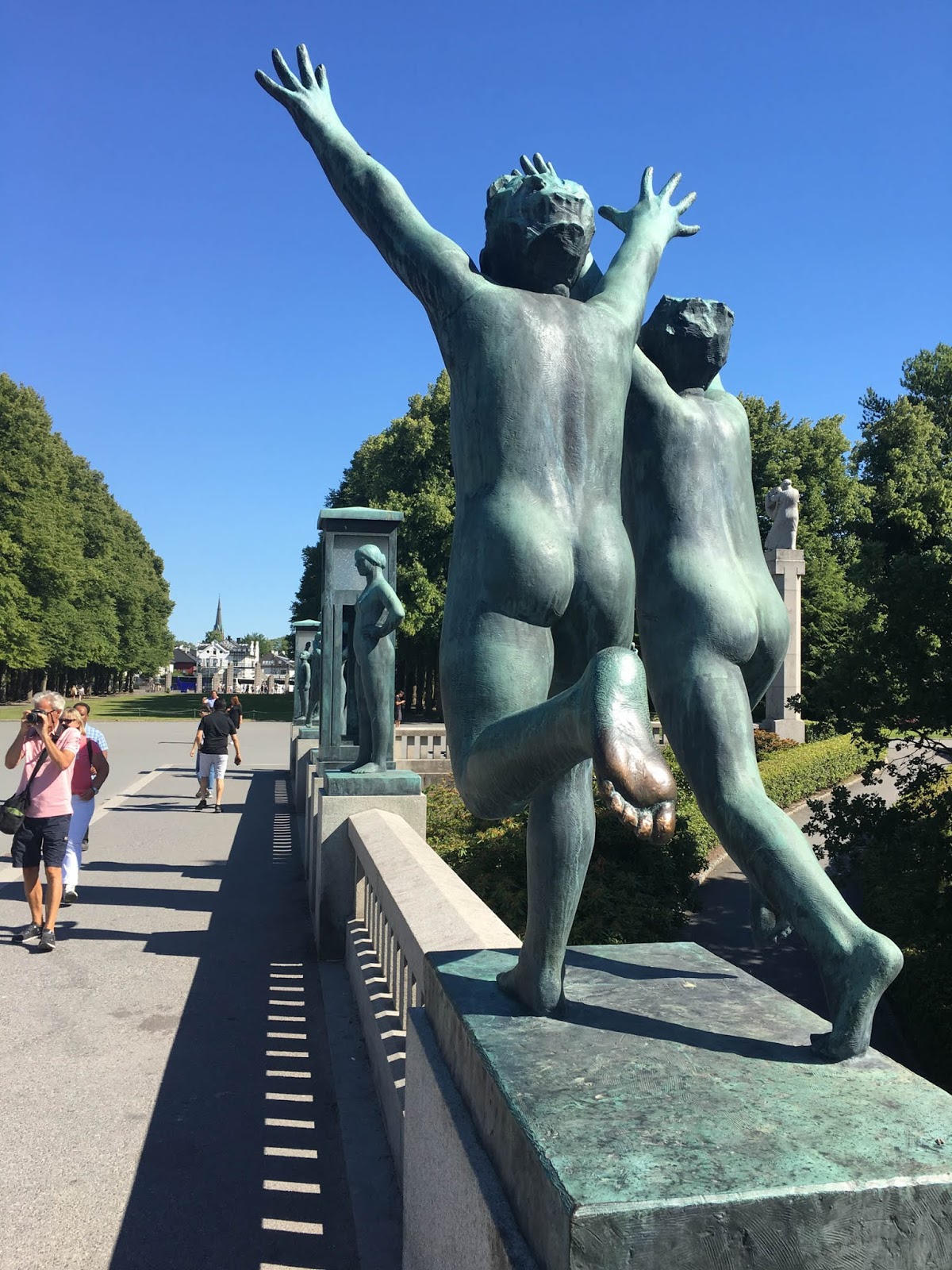
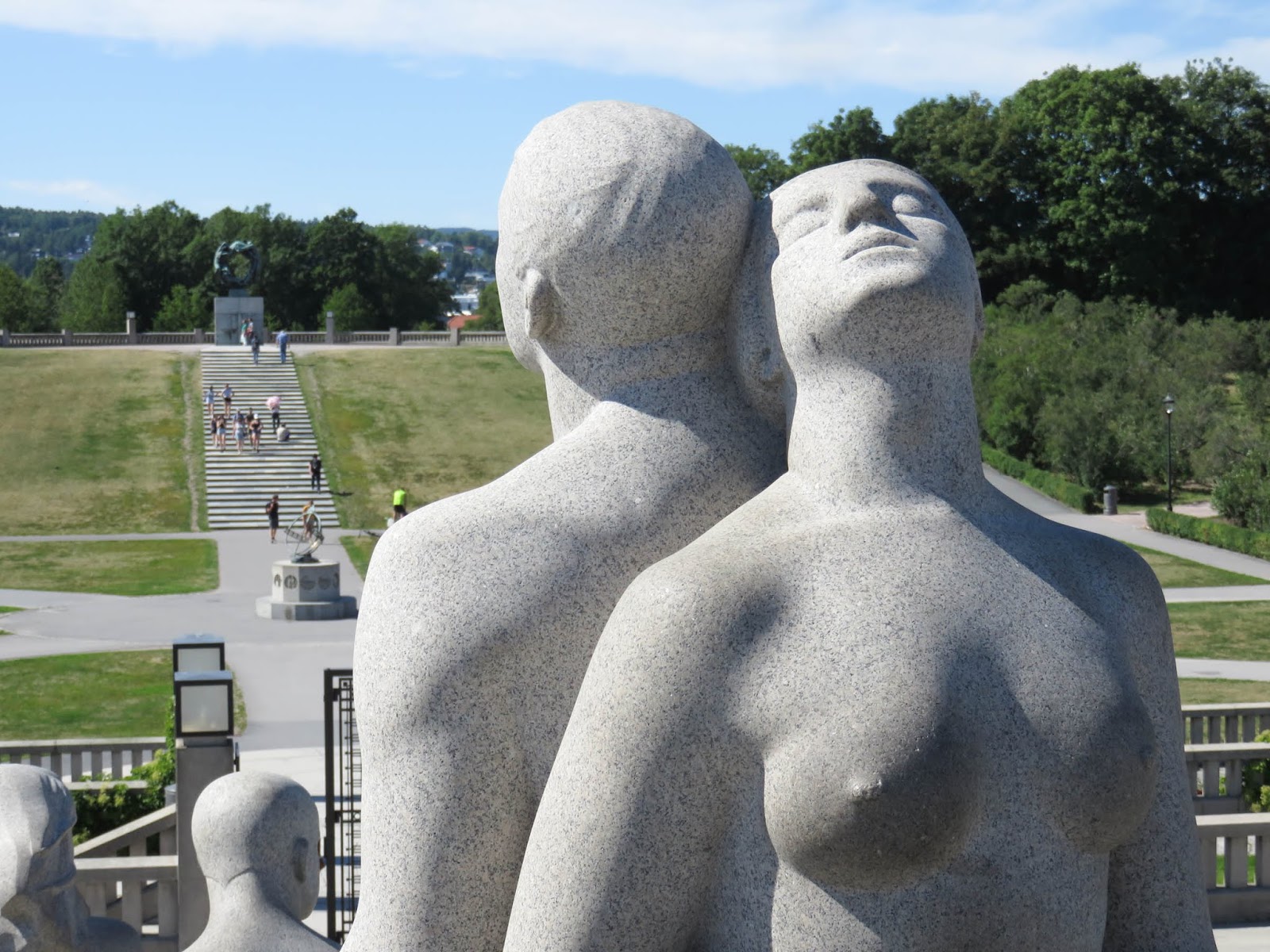
The entire project was conceived of and populated by Gustav Vigeland, mainly in the 1930s and 40s. It is not surprising why this is such a huge draw for both locals and tourists. The sculptures, all nude, are whimsical, thoughtful, provocative, and convey a wonderful sense of humanity. They were a nice contrast to classical sculpture. And there was sexuality, but without titillation.
Labels:
norway,
scandinavia2018
Location:
Unnamed Road, 0268 Oslo, Norway
Oslo
We spent our last two Norway days in Oslo, staying at a small hotel (Saga) in a neighborhood west of downtown. The trip from Lillehammer had been pretty quick and we were able to check in by 2pm, leaving us time to walk over to the nearby Vigeland Sculpture Park (which is part of the much larger Frogner Park).
We'd picked out an Indian restaurant for dinner, but it was closed for remodeling and we had to improvise. Which we did very successfully, ending up eating outside at a really good Thai place (Plah). We also ate outside the next night, on the sidewalk at a Tapas bar (Deli Majorstuen) a few blocks from our hotel. Breakfasts both days, as usual, were at the hotel. Lunches, also as usual, were fairly ad hoc.
We spent Tuesday (July 3rd) balancing our desire to explore the city with our distaste for temperatures above 30°C (high 80s Fahrenheit). We both whined a little and we stuck to the shade and to A/C (scarce in Oslo) as much as we could, but we actually managed to make a pretty good day of it. And a full one, too.
By the time it was over, we had wandered around downtown, the harbor front, and the Royal Palace, taken the water taxi to Bygdøy Island to see the Folkemuseum and the Viking Ship Museum, checked out the murals in City Hall, and visited the Opera House. Late in the afternoon, we took the T-Bane up to the Holmenkollen ski jump, then headed back into town for dinner. All of these will be covered in the next few posts.
We'd picked out an Indian restaurant for dinner, but it was closed for remodeling and we had to improvise. Which we did very successfully, ending up eating outside at a really good Thai place (Plah). We also ate outside the next night, on the sidewalk at a Tapas bar (Deli Majorstuen) a few blocks from our hotel. Breakfasts both days, as usual, were at the hotel. Lunches, also as usual, were fairly ad hoc.
We spent Tuesday (July 3rd) balancing our desire to explore the city with our distaste for temperatures above 30°C (high 80s Fahrenheit). We both whined a little and we stuck to the shade and to A/C (scarce in Oslo) as much as we could, but we actually managed to make a pretty good day of it. And a full one, too.
By the time it was over, we had wandered around downtown, the harbor front, and the Royal Palace, taken the water taxi to Bygdøy Island to see the Folkemuseum and the Viking Ship Museum, checked out the murals in City Hall, and visited the Opera House. Late in the afternoon, we took the T-Bane up to the Holmenkollen ski jump, then headed back into town for dinner. All of these will be covered in the next few posts.
Labels:
norway,
scandinavia2018
Location:
Oslo, Norway
Monday, July 30, 2018
Lillehammer
Back in the spring, Lillehammer had seemed like a good place to stop before our final leg into Oslo. I'd booked a room at the Scandic. Which turned out to be quite the place. Most of the Scandic Hotels we'd seen were fairly typical chain places, but here they've acquired something with a bit more history. It was high up above town on the side of the valley, not far from from the ski jump. The only downside was that it wasn't air conditioned. And the weather was very hot - more Italy than Norway.
We had dinner at a restaurant downtown (Nikker's), on an outside deck above the steep little stream that flows through town.
Lillehammer entered my vocabulary during the 1994 Olympics (remember Tonya Harding and Nancy Kerrigan?). I don't remember much about the games, but apparently the Opening and Closing Cermonies were held up at the ski jump.
We drove up to the ski jump (Lysgårdsbaggen) in the evening, then came back the next morning to ride the chair up to the top. We were thinking mainly about the view, so were completely surprised to find that there were ski jumpers training on the hill. It looks like they were using standard equipment, but the in-run is equipped with little rollers and the landing is on artificial turf.
We had dinner at a restaurant downtown (Nikker's), on an outside deck above the steep little stream that flows through town.
Lillehammer entered my vocabulary during the 1994 Olympics (remember Tonya Harding and Nancy Kerrigan?). I don't remember much about the games, but apparently the Opening and Closing Cermonies were held up at the ski jump.
Labels:
norway,
scandinavia2018
Location:
Lillehammer, Norway
Subscribe to:
Posts (Atom)