Wednesday, September 19, 2012

Red Wing


I didn't know how long we would be needed in Northfield, so I hadn't wanted to plan a long day on Sunday.  Red Wing was close and seemed a nice place to spend the first night of our trip back - even though it was in the opposite direction as Seattle.  We checked out the river, which was much lower than when I visited in June (Red Wing: June 2012), explored some pottery stores, drove up to Sorin's Bluff in Memorial Park (I went back up early the next morning when the light was better), and found a fairly character-free dinner north of town.  We stopped at Hanisch's Bakery on the way out of town - if only we hadn't been so stuffed from breakfast at the Moondance.


Cowling Arboretum


We all stuffed ourselves at the Ole Store for brunch, then dropped D on campus.  M and I didn't have far to go (Red Wing is less than 40 miles away) and we needed to walk off the Eggs Benedict and the Stuffed French Toast so we wandered around the upper Arb. The forest was nice, but the prairie portion was what I enjoyed the most.

Carleton College


D and I left Northfield in the late afternoon of June 4th.  Now, three months later and with another 5000 miles on the car, we've returned with Mom to deliver him, his summer stuff, and his bike back to Carleton.

We helped him get moved into his new dorm and then M and I watched the reenactment at the Return of Jesse James Days.  Okay, now we've done that.  We weren't all that impressed - although clearly this show is a big part of this town's history (along with the foiled bank robbery it portrays). I suspect this is the kind of thing that reinforces right wing mythology and the peculiar notion held by some 21st-century suburbanites that we would all be safer if we carried guns!


Duluth


Two years ago, we passed through Duluth on our way east on Route 2 (Duluth: June 2009).  It was fogbound and we didn't stay very long.  This time, the weather was better and we had reservations at the upscale Canal Park Lodge right on the lake.

Duluth almost got wiped out by an amazing rainstorm in June of this year -- but down on the lake we saw little evidence of it.


Naniboujou Lodge


If I hadn't accidentally found this place while I was exploring our route with Google Earth and Panoramio prior to the trip, we would have just driven right on by.  As it was, we not only got a chance to check out a fantastic piece of idiosyncratic architecture and history, but got a great lunch, too!

The idea was an exclusive boy's club in the 1920s, attracting the likes of Jack Dempsey and Babe Ruth.  The Great Depression got in the way of the grander schemes, but it persisted and has now been fixed up very nicely.

Lake Superior


Our route from Seattle to Minnesota was largely beach-free so the detour east to Thunder Bay was intentional - we needed some sort of coastline to give us a break from days of prairie.

The weather was nice for traveling, but the off and on overcast made the photography a challenge at times.  It was also a fairly quick tour - most of the my stops were short with M and D lingering in the car on their iPhones while I ran down to the beach and took a few pictures.  D joined me to skip rocks a couple of times and we all took the short hike down to Sugarloaf Cove, where D tried to teach M new Frisbee throws while I - you guessed it - took pictures of the beach.


Pigeon River


The Pigeon River marks the Minnesota - Ontario border for a few tens of miles before it enters Lake Superior.  It was a significant route inland from the Great Lakes for those folks trying to get their canoes and pelts back and forth from the west.  But first they had to portage some significant waterfalls where the river makes the final plunge to lake level.  This is the high falls - just a mile or so inland from Lake Superior.


Friday, September 14, 2012

Thunder Bay


Thunder Bay marked the eastern end of our slightly circuitous trip to Minnesota.  As usual, I was up early and drove out to Chippewa Park south of town and then to Marina Park in the north part of the city.  The lake was remarkably calm on this beautiful morning.  Despite this being the largest of all lakes, Thunder Bay is still a bay and its horizon is marked by the "Sleeping Giant" on the Sibley Peninsula.

Eventually, I retrieved M and D, we checked out, and then drove up to Mount McKay for an overview of the city.  Then it was off for the border and a return to the U.S.

Kakabeka Falls


The Kaministiquia River flows east into Lake Superior at Thunder Bay.  20 miles west of the city and conveniently near the highway, it plunges 130' over Kakabeka Falls.  We pulled in just at sunset for a brief sightseeing stop at the tail end of a very long day of driving.

Western Ontario


You don't have to drive through western Ontario to get from Winnipeg to southern Minnesota, but it helped satisfy my need for geographic variety and completeness.

About 30 miles east of Winnipeg - near Steinbach - the flat, largely treeless prairies end (we're almost 900 miles from the Rockies) and the Canadian Shield begins.  The land starts to rise and the cultivated fields turn to forest. It's another few tens of miles before you begin to see bedrock along the roadside.  And then it's hills and forest and ancient rocks all the way east - although this trip we only went as far as Thunder Bay.

Somewhere between Dryden and Thunder Bay we crossed into the eastern time zone and a little farther on we left the Hudson Bay watershed and entered the St. Lawrence drainage.  I love crossing these continent-scale divides. The so-called Great Divide (the Rocky Mountain crest which divides east and west flowing rivers) is just the most prominent continental divide in North America, but there are many others.  Like this one in Ontario.  Later this trip M and I drove west past a Continental Divide sign on I-94 in North Dakota between Valley City (Sheyenne River - Red River - Nelson River - Hudson Bay) and Jamestown (James River - Missouri - Mississippi - Gulf of Mexico).

Another piece of geographic trivia. When you drive across Canada, you enter Ontario west of Minneapolis and Des Moines.  You leave it at the same longitude as New York City.  That's one wide province!

Winnipeg


M and I were just here in Winnipeg a year ago and now we're back.  I guess it's sort of on the great circle route between Seattle and Northfield. Last year, we spent an hour or two at the Forks, eating lunch and walking along the river.  This time we spent the night and I was out early the next morning on D's bike checking out the river and the bridges.  Last year, the Red River was still recovering from the floods of the previous year, but the evidence of those is fading quickly.


Cypress Hills


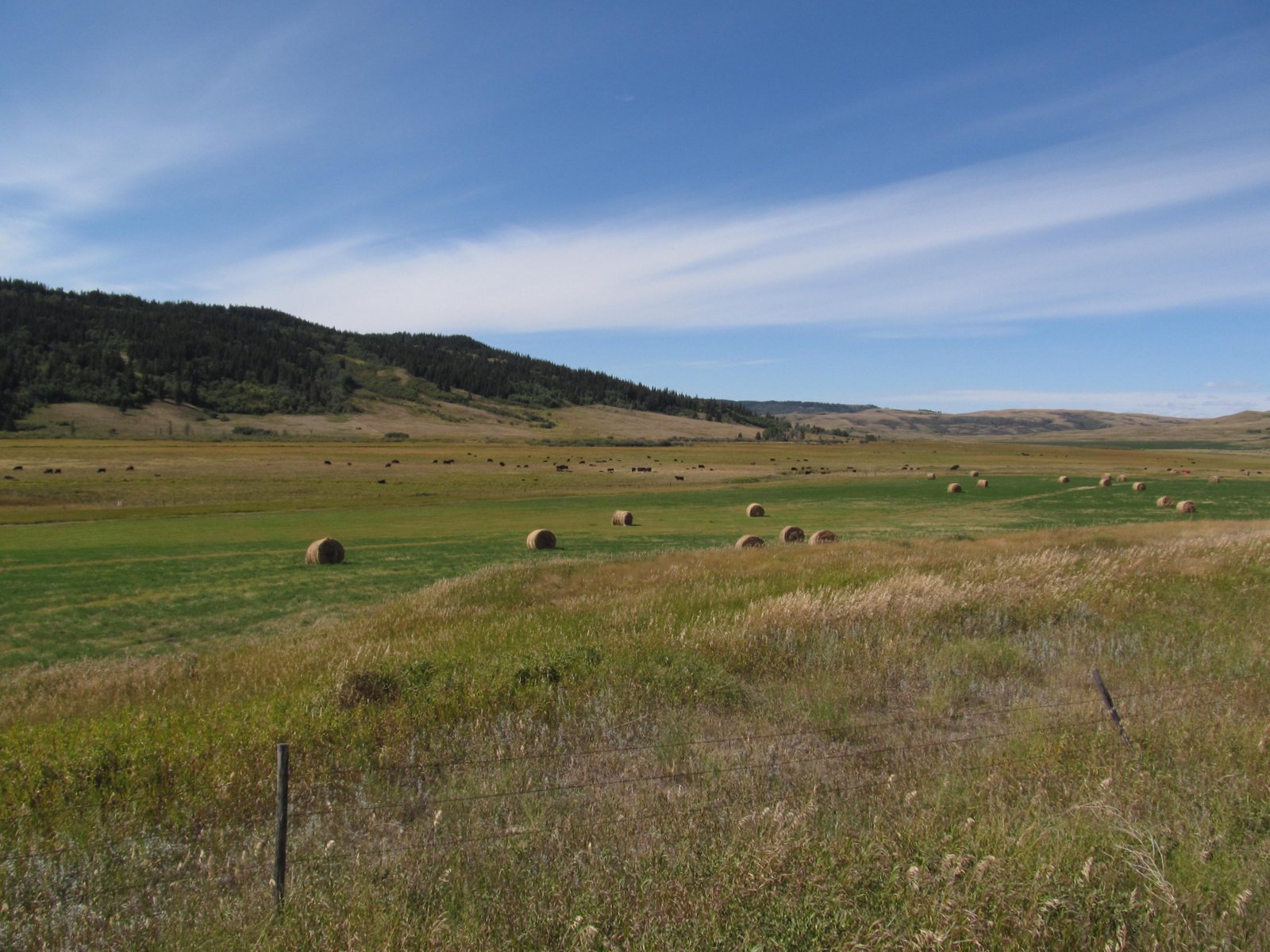
Today's itinerary offered a direct route from Lethbridge to Regina.  But my route (and therefore the family's route) took in a loop south from Medicine Hat so we could explore the Cypress Hills.  It was the end of a long weekend and there was a steady stream of RVs heading back to Calgary and the other prairie towns as we drove in.

The prairies are powerful places for me - thanks, I suppose, to long family driving trips as a kid and a fair amount of time spent living in oil towns in these wide open grasslands that fan east from the Rockies. As much as I love the Rockies, it was reaching the prairie east of Crows Nest Pass yesterday afternoon that moved me the most.  Endless rolling late season wheat fields back lit by the low sun helped, too.

The Cypress Hills are a small remnant of an earlier higher prairie - one long since removed elsewhere by meandering rivers flowing east.  Its height left it perched above the glaciers, so the partially forested surface is an extremely old one in this part of the world where most landscapes are young (if 12,000 years is young).  One of these photos shows how flat the upper surface remains - the very fact that it is higher than its surroundings means that there are few streams to erode it, except at its margins (and there, only slowly).

I find these little bits of high country surrounded by prairie enchanting.  Riding Mountain National Park in Manitoba. The Turtle Mountains on the North Dakota-Canada border.  The Rockies are full of small mountain ranges surrounded by high sage steppe, but these are lower, more remote from the mountains, and much more subtle.

These were important places for First Nations peoples.  They harbored game, provided water and refuge, offered timber for shelter and firewood.  They were strategic landmarks.  They were often the sites of skirmishes as settlers moved into the region.  They have also shaped western literature and sensibilities.  Wallace Stegner lived south of here and wrote Wolf Willow about that time.